

Pharmacogenomic testing reads your DNA to predict how your body will process and respond to specific antidepressants. It won’t hand you a guaranteed answer, but it helps your doctor skip medications likely to cause side effects or fail based on genetic markers like CYP2D6 and CYP2C19. If you’ve tried multiple antidepressants without success or experienced serious side effects, this test warrants a focused clinical conversation with your prescribing physician.
Selecting the right antidepressant has long challenged both clinicians and patients. The standard approach requires initiating a medication, observing outcomes over four to six weeks, and restarting the process if the drug proves ineffective or poorly tolerated. Pharmacogenomic testing addresses this gap by applying genetic data to prescribing decisions at the outset, before the trial and error begins.
Psychiatrists and primary care physicians are increasingly adopting this approach as psychiatric care moves toward precision medicine. Understanding how pharmacogenomic testing works, what it can and cannot accomplish, and when it is clinically appropriate will help you engage your provider in a well-informed treatment discussion.
What Is Pharmacogenomic Testing?
Pharmacogenomic testing analyzes specific genes that regulate hepatic drug metabolism. For antidepressants, the primary genes of interest encode enzymes in the cytochrome P450 family, particularly CYP2D6 and CYP2C19. These enzymes are responsible for metabolizing the majority of commonly prescribed antidepressants, including:
- SSRIs like sertraline (Zoloft) and escitalopram (Lexapro)
- SNRIs like venlafaxine (Effexor)
- TCAs like amitriptyline and nortriptyline
The specimen collection process is straightforward. A buccal swab or blood sample provides sufficient DNA for analysis. Results classify patients into one of five established metabolizer phenotypes: poor, intermediate, normal, rapid, or ultrarapid.
A poor metabolizer lacks sufficient enzymatic activity to break down certain drugs at a standard rate. Drug concentrations accumulate in the body, elevating the risk of adverse effects even at conventional doses. An ultrarapid metabolizer, by contrast, clears medications so rapidly that standard doses may fail to reach or sustain a therapeutic plasma concentration.
Knowing your metabolizer phenotype gives your physician actionable pharmacokinetic context before the first prescription is written.
How Does Genetic Testing Help You Find the Right Antidepressant?
Pharmacogenomic results do not identify a single optimal antidepressant. They do, however, identify which medications carry elevated risk for poor tolerability or inadequate response based on your individual metabolizer status.
As a practical example, a patient identified as a CYP2D6 poor metabolizer would benefit from avoiding paroxetine (Paxil), a substrate heavily dependent on that enzyme, in favor of an agent that follows an alternate metabolic pathway. That single data point can eliminate several problematic options before any medication is prescribed.
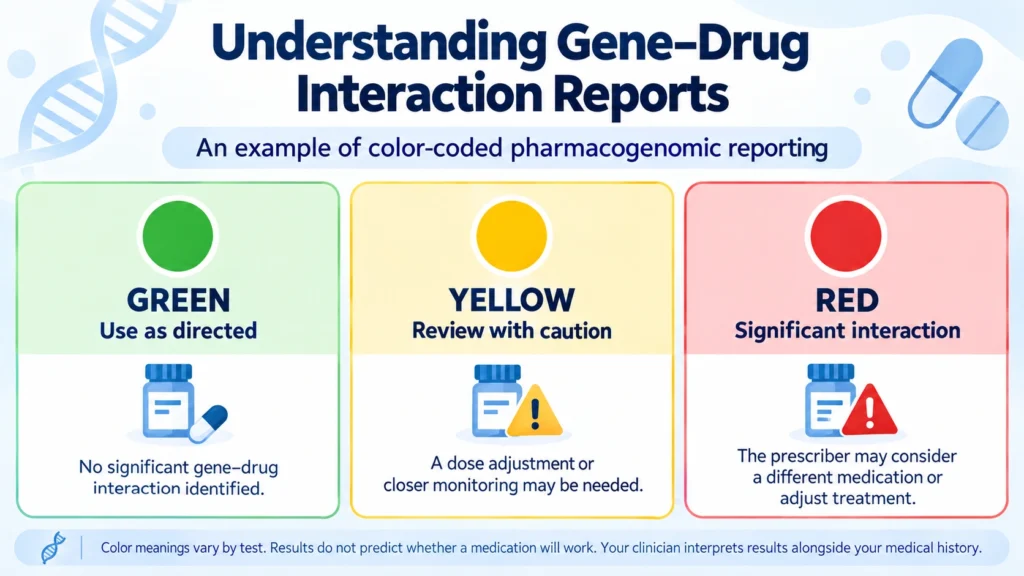
Most clinical decision support tools apply a structured, color-coded reporting format to communicate the degree of gene-drug interaction:
 Green — Use the medication as directed; no significant interaction detected
 Yellow — Proceed with caution; consider dose adjustments
 Red — Significant interaction; choose a different medication
This tiered framework, informed by CPIC guidelines, provides your clinician with an evidence-based structure for interpreting and acting on your genetic results.
Who Benefits Most from Pharmacogenomic Testing?
The clinical utility of pharmacogenomic testing is not uniform across all patient populations. Certain groups derive substantially greater benefit from the information it provides.
Patients with treatment-resistant depression represent the clearest indication for testing. If two or more antidepressant trials have failed to produce adequate response, genetic factors may be contributing to that pattern. The National Institute of Mental Health estimates that approximately one-third of individuals with depression do not respond adequately to first-line pharmacotherapy.
Patients who have experienced severe or atypical adverse effects are also strong candidates. When a patient reacts unexpectedly to a standard dose, metabolizer status frequently plays a role, and genetic data can clarify whether dose adjustments or an alternative agent are more appropriate.
Patients managing complex polypharmacy regimens benefit from the pharmacokinetic clarity that genetic testing provides. The more concurrent medications a patient takes, the greater the potential for drug-drug interactions, and pharmacogenomic data helps prescribers assess whether a new antidepressant can be added safely.
Patients initiating antidepressant therapy for the first time may also consider testing if they wish to reduce diagnostic uncertainty from the start. The supporting evidence in this population is less robust than in treatment-resistant cases, but proactive testing remains a clinically reasonable option worth discussing with your physician.
Does the Research Actually Support Pharmacogenomic Testing?
The evidence base for pharmacogenomic-guided antidepressant prescribing continues to expand, though study findings remain heterogeneous. The GUIDED trial, published in the Journal of Psychiatric Research (2019), demonstrated that patients whose treatment was guided by pharmacogenomic data achieved significantly greater symptom reduction by week 8 compared to patients receiving standard care. Other investigations have reported more modest benefits, and some researchers emphasize that testing is most effective as one component of a comprehensive treatment strategy rather than a standalone intervention.
The American Psychiatric Association has not issued a broad endorsement of routine pharmacogenomic testing for all patients beginning antidepressant therapy, reflecting the reality that the evidence base, while encouraging, continues to mature. The Clinical Pharmacogenetics Implementation Consortium (CPIC) has published specific prescribing recommendations for several antidepressants based on CYP2D6 and CYP2C19 phenotype, offering clinicians a peer-reviewed framework for translating genetic results into treatment decisions.
The clinical consensus is clear: pharmacogenomic testing is a useful adjunct to clinical judgment, not a replacement for it.
What Are the Limitations You Should Know About?
Before pursuing pharmacogenomic testing, patients and clinicians should understand the scope of what the test does and does not measure.
Genetic variants account for only one dimension of antidepressant response. Disease severity, comorbid medical conditions, concurrent substance use, and even gut microbiome composition all influence how a patient responds to pharmacotherapy. No genetic panel captures the full complexity of that interaction.
Insurance coverage presents a practical barrier for many patients. Some payers cover pharmacogenomic testing when prior treatment failures are documented. Others offer no coverage, leaving patients responsible for costs ranging from $100 to $500 out of pocket depending on the laboratory and the breadth of the testing panel. Verifying coverage before ordering is strongly advisable.
Equally important is the need for a clinically experienced provider to interpret and apply the results. A pharmacogenomic report delivers no therapeutic value if the prescribing clinician lacks the training to integrate findings into a coherent treatment plan. Testing yields the best outcomes when ordered and reviewed by a provider with demonstrated expertise in pharmacogenomics.
When Should You Actually Get Tested?
Pharmacogenomic testing carries the strongest clinical justification when conventional prescribing has not produced adequate results. Patients who have completed multiple antidepressant trials without meaningful symptom relief, or who discontinued treatment due to intolerable adverse effects, stand to gain the most clinically relevant information from this test.
For patients beginning their first antidepressant course with no complicating history, the evidence supporting routine testing is less compelling. A methodical, stepwise prescribing approach combined with consistent clinical monitoring may achieve comparable outcomes at lower cost.
For patients who choose to proceed with testing, three questions are worth raising directly with your physician:
- Which laboratory do you use, and what genes are included in the panel?
- Will the results meaningfully change the medications you consider prescribing?
- How will we integrate genetic data with the broader factors shaping my treatment plan?
Pharmacogenomic testing functions most effectively as a precision tool for narrowing the medication landscape and reducing avoidable risk. It complements, rather than replaces, careful clinical assessment, transparent patient-provider communication, and ongoing treatment monitoring.
Pharmacogenomic Testing at Amrit Mind & Body Wellness
At Amrit Mind & Body Wellness, we consider pharmacogenomic testing as part of a broader psychiatric evaluation. Our team reviews results alongside your symptoms, medication history, and treatment goals rather than relying on the report alone.
If you have questions about your antidepressant treatment, explore our pharmacogenomic testing service in Lathrop, California. You can also learn how psychiatric medication management supports treatment reviews and follow-up care.
Schedule a consultation with Amrit Mind & Body Wellness to discuss whether testing could add useful information to your care.
How long does pharmacogenomic testing for antidepressants take?
Turnaround time depends on the laboratory and testing panel. At Amrit Mind & Body Wellness, results typically take one to two weeks, depending on the laboratory. Ask our team about the expected timeline before testing.
Does pharmacogenomic testing replace monitoring for antidepressant side effects?
No. Testing may help your provider identify certain gene–medication interactions, but it cannot predict every side effect or guarantee treatment success. Your prescriber still needs to monitor your symptoms, side effects, and response to medication through regular follow-up appointments.
Are there risks associated with pharmacogenomic testing?
Sample collection usually involves a cheek swab, saliva sample, or blood draw. Cheek swabs and saliva collection are noninvasive; a blood draw may cause brief discomfort or bruising. Ask how the laboratory protects your genetic information, and review your results with a qualified provider who considers your full medical history.
Can I receive effective antidepressant treatment without pharmacogenomic testing?
Yes. Your provider can select and adjust treatment using your symptoms, medical history, previous medication response, and follow-up assessments. Pharmacogenomic testing is an additional tool, not a requirement for every patient.